
Pablo Puente
AA · University of Illinois College of Medicine in Chicago
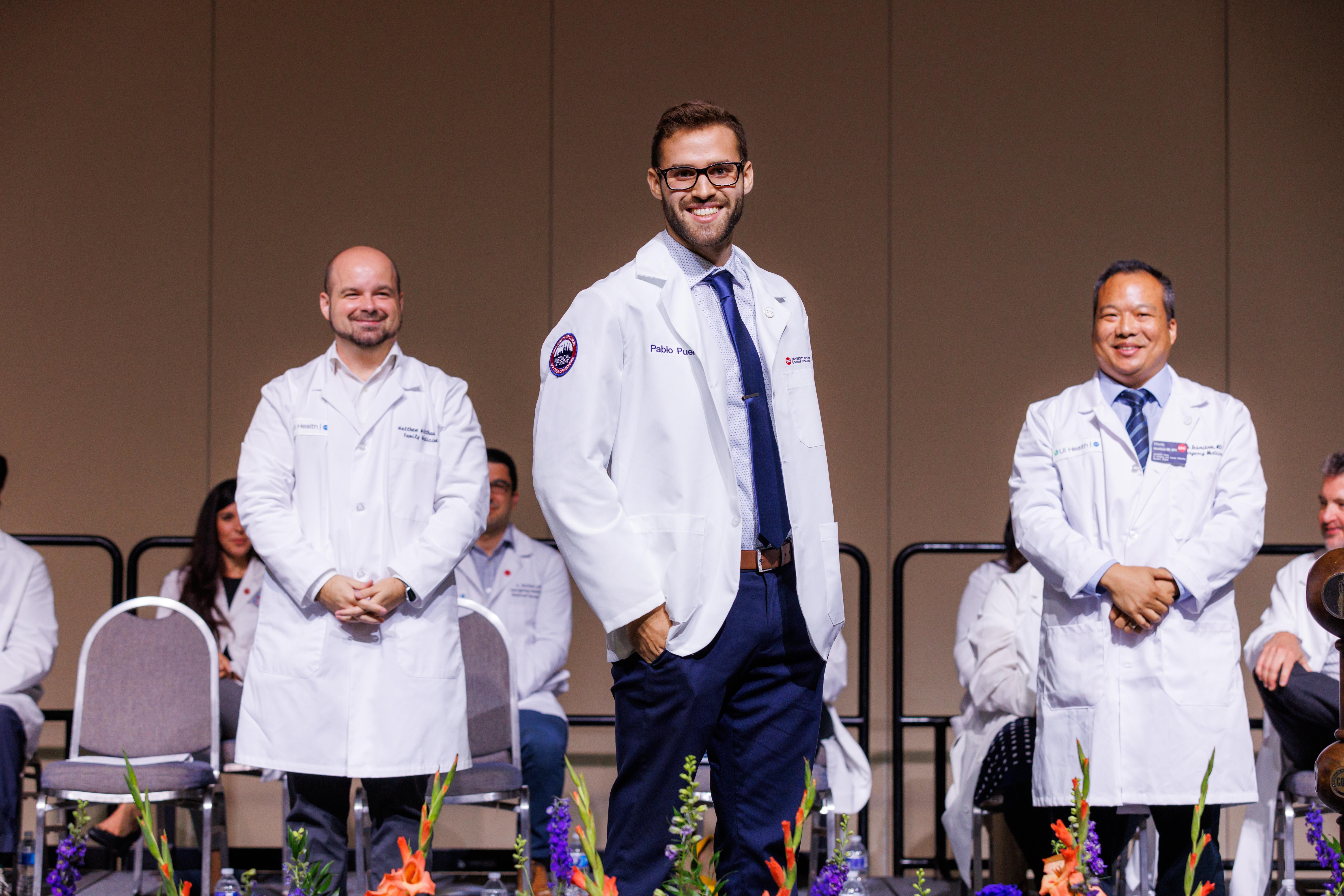
For Pablo, medicine was never simply about science. It was about people.
Born in Puerto La Cruz, Venezuela, Pablo immigrated to the United States at just twelve years old, settling in Miami and navigating a new language, culture, and educational system. As a first-generation immigrant and the first member of his family to graduate from college in the United States, his path to medicine was anything but conventional.
Long before white coats, research presentations, and national leadership positions, there was music.
Some of Pablo's earliest memories of illness involve sitting at a piano, playing songs for his grandmother as she battled breast cancer. Cancer had already deeply touched his family. His maternal grandfather succumbed to colon cancer, while his paternal grandfather lost his battle with non-Hodgkin lymphoma. At an age when words often fail, music became a way for a young boy to offer comfort to the people he loved most.
"Music allowed me to comfort her, even when I did not fully understand everything she was experiencing," but "I wanted to do more than provide comfort, I wanted to understand disease, help patients navigate frightening diagnoses, and participate directly in their treatment and recovery."
That desire crystallized during his volunteer work at a children's hospital, where he met a young patient who was living with renal failure. Through music, the two developed a connection. But during one visit, Pablo witnessed a medical emergency unfold.
As physicians and nurses rushed to respond, Pablo recognized the limitations of what he could offer in that moment. He could provide comfort, but he wanted to be able to step forward with the medical knowledge and skills necessary to help care for a patient. That experience strengthened his decision to pursue medicine and shaped the kind of physician he hopes to become.
By that point, however, Pablo had already begun building the foundation for his future. Through Doral College's dual enrollment program, he earned his Associate of Arts degree while still in high school, balancing college-level coursework alongside the responsibilities of adolescence. The experience demanded discipline, independence, and maturity; skills that would later prove invaluable throughout his undergraduate years, medical school, and beyond.
Today, Pablo is a fourth-year medical student at the University of Illinois College of Medicine in Chicago and expects to graduate in May 2027. He plans to pursue a residency in urology, focusing on urologic oncology, health disparities, and expanding access to care for Hispanic and underserved communities.
His résumé is impressive by any measure.
Pablo serves as an Urban Medicine Program Scholar, has held leadership roles within his medical school's Urology Interest Group, and recently led the Urology Specialty Section of the Latino Medical Student Association. He was also selected to serve on the American Urological Association's Medical Student Membership Workgroup.
Yet his greatest passion lies in research.
Working with teams at the University of Illinois Chicago, the University of Miami, and the University of Southern California, Pablo studies disparities in urologic cancers, examining differences in treatment access and outcomes among racial and ethnic groups. His work challenges the tendency to treat Hispanic patients as a single demographic category and seeks to better understand the unique experiences of different communities.
His research has been presented at national conferences focused on urology, Latino health, cancer, and surgical research. Along the way, he has earned numerous honors, including the National Hispanic Health Foundation’s Professional Student Scholarship, the 2023 UIC LMSA Dr. José Ignacio Choca Scholarship, the 2024 Hector Perez Garcia, MD Social Justice Award, the 2026 José Celso Barbosa, MD Outstanding Scholar Award, and being selected as a MOLA–Michael Reese Foundation Scholar.
Despite these accomplishments, Pablo measures success differently.
“My proudest accomplishment is becoming a first-generation physician-in-training while remaining connected to the people and communities that helped me get here," he says.
For him, medicine is more than a career. It is a reflection of his family's sacrifices, those who believed in him, and a commitment to opening doors for others.
As he prepares for residency applications and the next chapter of his journey, Pablo hopes to become a physician who does more than treat disease. He aspires to combine clinical competence with the ability to see, understand, and support the person behind the diagnosis, making patients feel heard and respected, communicating in ways that patients and families can understand, and advocating for communities that have historically been overlooked. It is this commitment that continues to drive both his career aspirations and his research on racial and ethnic disparities in cancer care.
For current and future Doral College students, his message is simple:
“Do not underestimate yourself because of where you come from or because you are the first in your family to pursue a particular path. There will be moments when you feel as though everyone else knows more than you do, but keep showing up, stay curious, and remember that you have earned the right to be there.”